

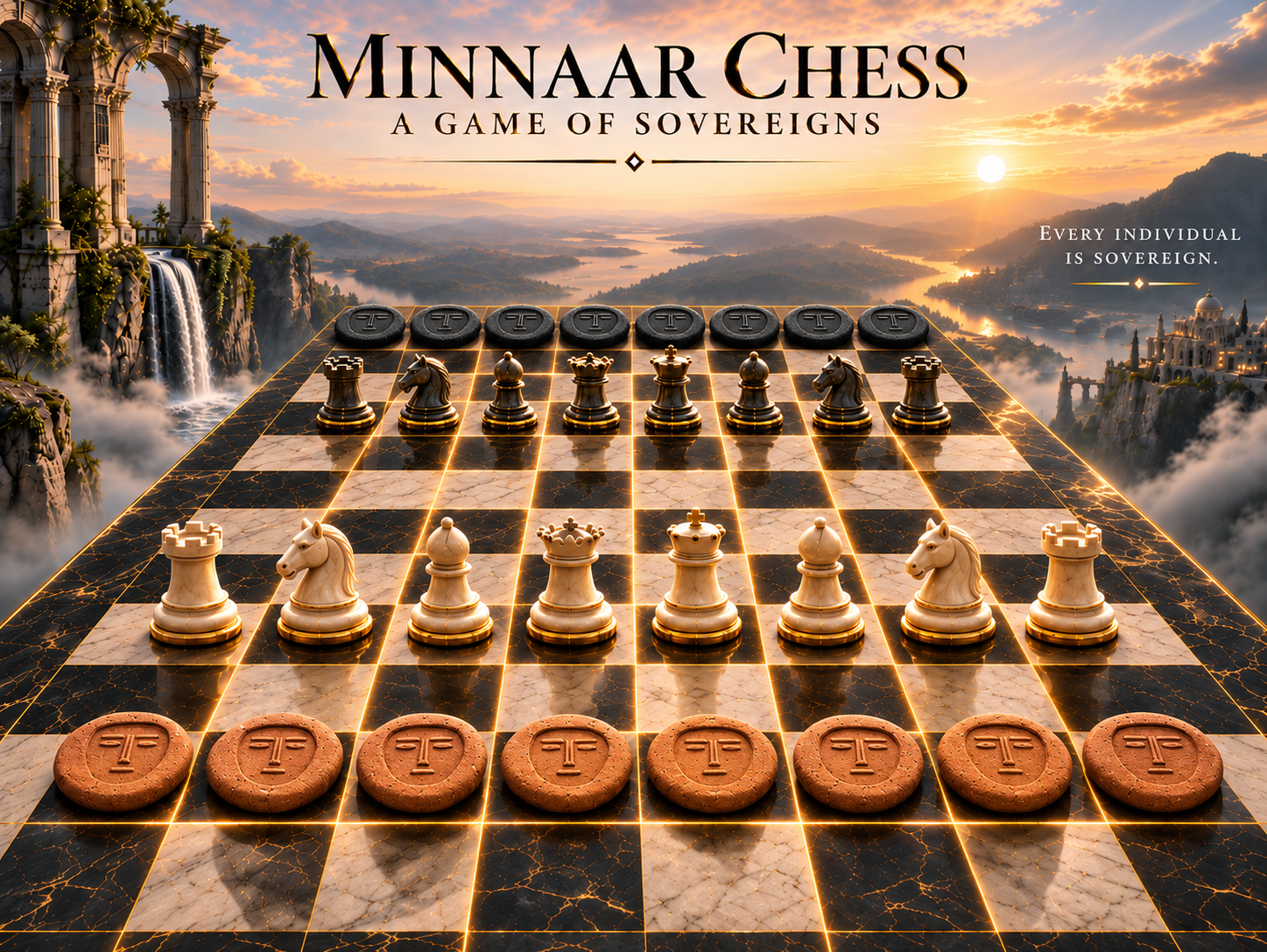
MINNAAR CHESS
A Game of Sovereigns
A Chess Game Where Both Players Can Win.
Created by Steven Minnaar
Every Individual Is Sovereign.
The Object of the Game
Minnaar Chess reimagines traditional chess through the philosophy of Sovereign Individualism.
The pieces traditionally considered the least powerful become the most powerful. Kings surrender their special privileges, and every player pursues an independent objective.
Victory is achieved through sovereignty. Both players can win.
The game offers two variations:
- Standard Play: Two Sovereigns must reach the opposite back rank. Estimated playing time: 8–15 minutes.
- Contemplative Play: One Sovereign must reach the opposite back rank, with movement limited to two squares. Estimated playing time: 17–34 minutes.
Both variations use a traditional chessboard and its 32 pieces.
I. Setting Up the Board
Use a traditional 8 × 8 chessboard with the light-colored square at the bottom-right corner of each player's side.
Each player begins with 16 pieces.
Back Rank — The Sovereigns
Place all eight traditional pawns across the back rank:
- White: a1 through h1
- Black: a8 through h8
These eight pieces are now called Sovereigns.
Second Rank — The Traditional Pieces
Arrange the remaining pieces in their traditional order, directly in front of the Sovereigns:
Rook – Knight – Bishop – Queen – King – Bishop – Knight – Rook
- White: a2 through h2
- Black: a7 through h7
The four middle ranks begin empty.
Each traditional piece retains its recognizable appearance and identity, but its movement is changed.
II. Movement of the Sovereigns
Each Sovereign possesses the movement and capturing powers of a traditional queen.
A Sovereign may:
- Move horizontally, vertically, or diagonally.
- Move any number of unobstructed squares in Standard Play.
- Capture an opposing piece by moving onto its occupied square.
- Move backward, forward, or sideways.
A Sovereign may pass over empty squares but cannot jump over another piece.
Sovereigns cannot capture pieces belonging to their own player.
III. Movement of the Traditional Pieces
Kings, queens, rooks, bishops, and knights all possess the movement and capturing powers of traditional pawns.
Each may:
- Move one square forward into an empty square.
- Move two squares forward on its first move from its original starting square, provided both squares are empty.
- Capture one square diagonally forward.
- Continue moving only forward.
Forward means toward the opposing player's starting side.
Traditional pieces reaching the opposite back rank remain there, without promotion, and may subsequently be captured.
IV. The First Move — The Kings
White moves first, followed by Black.
Each player's first move must be made with their king.
Thereafter, players alternate turns, moving any eligible piece.
Kings have the movement and capturing powers of traditional pawns.
Kings have no special protection. They may be captured like any other piece.
The capture of a king does not determine victory.
V. Achieving Sovereignty — Standard Play
The objective is to bring two distinct Sovereigns to the opposing back rank.
A White Sovereign achieves passage by landing on any square of rank 8.
A Black Sovereign achieves passage by landing on any square of rank 1.
Upon reaching the opposing back rank:
- The Sovereign has successfully completed its passage.
- The Sovereign is removed from the board.
- One successful passage is recorded for its player.
A Sovereign may reach the opposite rank through any legal movement, including capturing an opposing piece on that rank.
Each Sovereign can complete only one passage.
When two of a player's Sovereigns have completed passage, that player achieves sovereignty.
If that player's king remains on the board, the king immediately abdicates and is removed.
The player's achievement is permanent, and gameplay continues while the other player pursues sovereignty.
VI. Capturing and Freedom of Choice
Capturing is optional.
Players may use their pieces to advance, defend, capture opposing pieces, or open passages across the board.
A captured Sovereign is permanently removed and cannot complete passage.
Players who have already achieved sovereignty continue taking turns until the game concludes. They remain free to defend, cooperate, or pursue other legal moves.
The game permits independent strategies and voluntary cooperation.
VII. Ending the Game
Each player's success is evaluated independently.
A player has achieved sovereignty when the required number of Sovereigns have completed passage.
A player can no longer achieve sovereignty when:
Successful passages + surviving Sovereigns on the board = fewer than the required number.
The game ends when each player's pursuit has been resolved through either success or the impossibility of completing the objective.
If one player can no longer succeed, the other continues playing until their own pursuit is resolved.
There are three possible outcomes:
Mutual Sovereignty — Both Players Win
Both players complete the required passages.
Individual Sovereignty — One Player Wins
One player completes the required passages, while the other is unable to do so.
Unrealized Sovereignty — Neither Player Wins
Neither player completes the required passages, and neither can still achieve the objective.
If a player has no legal move, that player passes their turn. Two consecutive forced passes end the game, with the outcome determined by each player's achievements.
Players may also end the game by mutual agreement. For extended play, an optional anti-stall rule ends the game after 100 consecutive individual turns without a capture or completed passage. In either case, completed passages determine which players have achieved sovereignty.
VIII. Contemplative Play — The Long Passage
This variation is designed for players who prefer longer games involving greater maneuvering, positioning, and strategic development.
All rules of Standard Play remain in effect, with two modifications:
1. Sovereign Movement
Each Sovereign may move up to two squares per turn horizontally, vertically, or diagonally.
All normal restrictions on blocked squares and captures continue to apply.
2. Achieving Sovereignty
Only one Sovereign must successfully reach the opposing back rank.
Upon completion, that player's king abdicates, and the player's sovereignty is recorded.
Both players may achieve sovereignty independently.
Estimated playing time: 17–34 minutes.
IX. Additional Rules
- There is no check or checkmate.
- Castling and en passant are not used.
- Traditional pawn promotion is not used.
- Sovereigns retain their queen-like movement throughout play, subject to the selected variation's movement limit.
- Players alternate turns throughout the game, including after achieving sovereignty.
- A player's achieved sovereignty cannot be reversed.
- Both players agree on Standard or Contemplative Play before beginning.
The Philosophy of Minnaar Chess
Traditional chess is a contest organized around protecting the king and defeating an opponent.
Minnaar Chess offers another possibility.
Each individual possesses the power to pursue sovereignty. Traditional authority has become equal in movement to every other traditional piece. The objective is personal achievement, and one individual's success can coexist with another's.
Players are free to compete, defend, cooperate, and make choices according to their own judgment.
The highest outcome is Mutual Sovereignty: a game in which both players achieve their objective.
Minnaar Chess celebrates a fundamental principle of Sovereign Individualism: individuals can freely pursue their own happiness and fulfillment while respecting the equal sovereignty of others.
Every Individual Is Sovereign.
MINNAAR CHESS
A Game of Sovereigns
A Chess Game Where Both Players Can Win.
Minnaar Money — The Art of Freedom
© 2026 Steven Minnaar. All rights reserved.
Version 1.0 — Play-Test Edition